

Answer Engine Optimization Malaysia (AEO): How SMEs Win Citations on Google AI & ChatGPT (2026 Guide)
Answer Engine Optimization Malaysia (AEO) is the strategic practice of structuring digital content so artificial intelligence engines—including Google AI Overviews, Perplexity, and ChatGPT Search—retrieve, extract, and cite your business as the definitive primary source, shifting visibility from traditional blue links to direct AI answers.
The search landscape across Southeast Asia has shifted from index-based ranking to automated answer synthesis. Google AI Overviews, ChatGPT Search, and Perplexity resolve commercial queries directly within search interfaces.
Corporate buyers across Kuala Lumpur, Penang, and Kota Kinabalu use AI engines for vendor evaluations. With AI overviews causing organic click-through rates to decline by 30% to 45%, Malaysian SMEs must adopt Answer Engine Optimization Malaysia strategies to secure primary citations inside synthesized responses.
Why Traditional SEO Is No Longer Enough for Malaysian SMEs
Traditional SEO in Malaysia no longer guarantees commercial inbound leads because generative search engines answer queries before visitors click external links. Conventional optimization secures discovery on search indexes, but generative engines summarize source material directly on the results page.
Traditional Search: Query ──► Keyword Index (BM25) ──► 10 Ranked Blue Links ──► Website Click
Generative AI Search: Query ──► Hybrid Retrieval ──► RRF Re-ranking (k=60) ──► Passage Extraction ──► AI Answer + Citations
When corporate buyers search for B2B solutions, AI Overviews and sponsored ads dominate the screen, pushing organic links beneath the fold.
Corporate buyers also bypass traditional engines entirely, using Perplexity and ChatGPT Search to evaluate suppliers. Aligning your organic search and Google Ads campaigns with an AEO strategy is necessary to sustain qualified pipeline growth.
How AI Answer Engines Retrieve and Cite Sources: Technical Mechanics
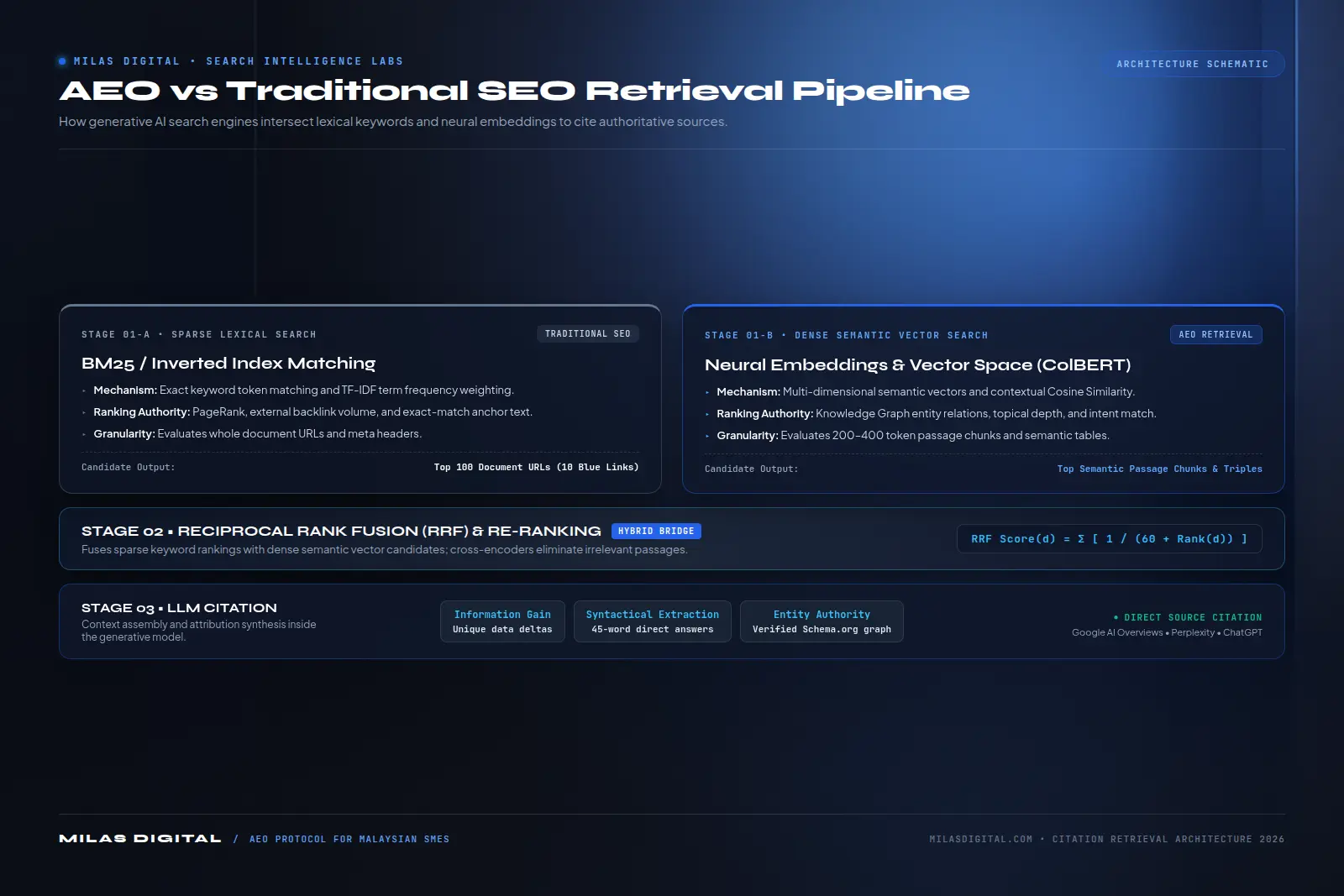
AI answer engines select citations through hybrid retrieval scoring passage semantic clarity over site-wide keyword density. Systems like Google AI Overviews, Perplexity, and ChatGPT Search evaluate three technical stages:
1. Hybrid Search and Reciprocal Rank Fusion (RRF)
Answer engines retrieve candidate pages by merging two search layers:
- Sparse Lexical Search (BM25): Identifies exact keywords, technical terms, and geographical markers.
- Dense Semantic Vector Search: Maps search queries into high-dimensional vector embeddings, identifying conceptual context across synonyms.
Retrieval systems merge these results using Reciprocal Rank Fusion (RRF, $k=60$):
$$RRF(d) = \sum_{m \in M} \frac{1}{rank_m(d) + 60}$$
Under RRF mechanics, pages performing consistently across lexical and semantic layers achieve higher composite ranks than pages relying on keyword stuffing.
2. Parametric Cutoffs and Live Search Triggers
Large language models do not query live web indexes for every prompt. LLMs initiate live searches for roughly 62% of queries—specifically when parametric memory lacks confidence. AI engines invoke live retrieval for temporal specifics (2026 Malaysian statutory regulations), granular numeric precision (pricing in Ringgit Malaysia), or localized geographic data (facilities in Sabah, Penang, or Selangor). Publishing verifiable operational figures forces language models to trigger live search and quote your data.
3. Passage Extraction and Confidence Scoring
Passage extractors analyze focused text blocks of 40 to 60 words. When a passage delivers a direct declarative answer, the model excerpts the text into the generated answer and attaches a primary citation link.
The Three Core Pillars of Generative Engine Optimization (GEO)
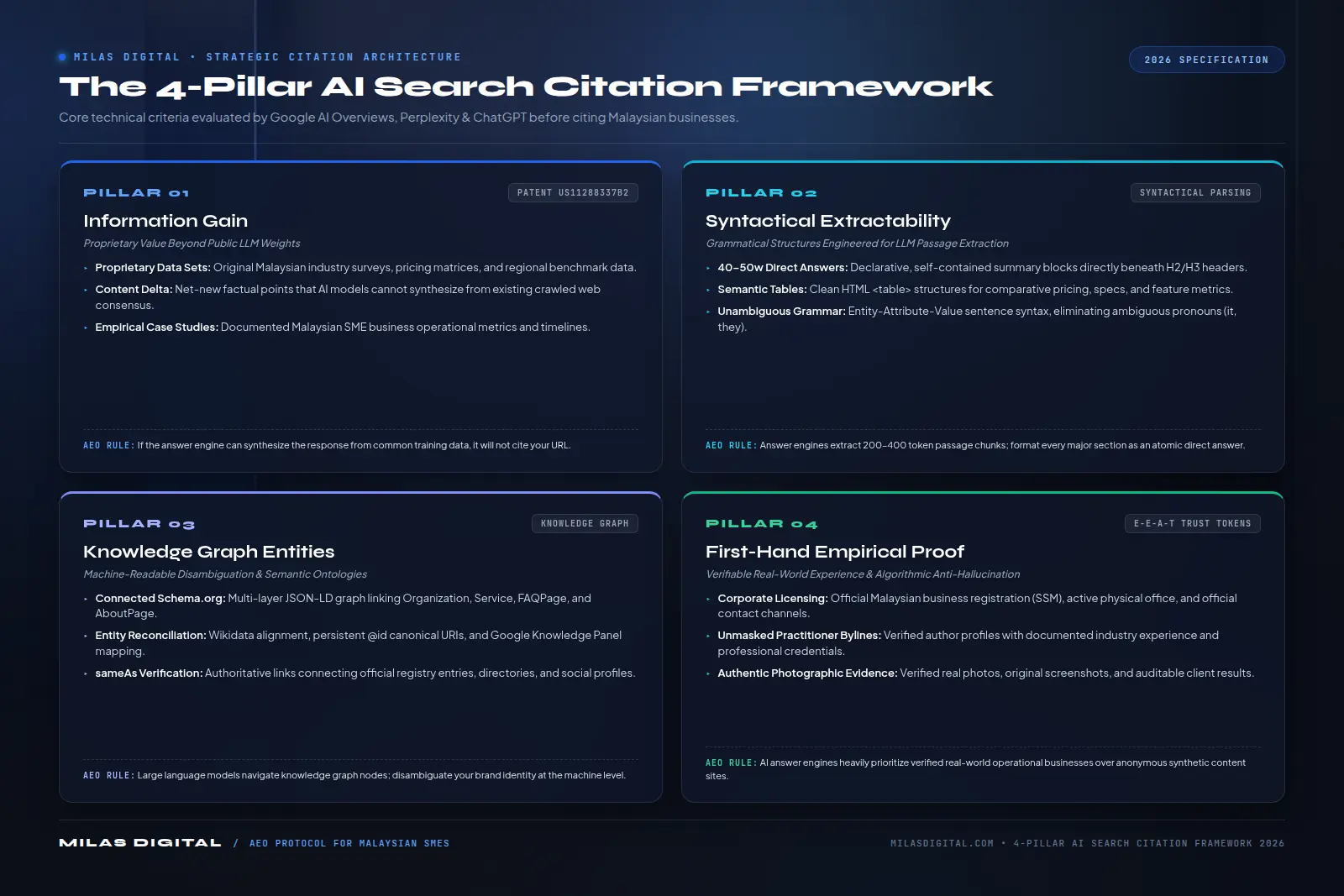
Earning citations across ChatGPT, Perplexity, and Google AI Overviews requires three evaluation criteria:
Pillar 1: Information Gain (Net-New Empirical Data)
Search algorithms evaluate whether an article contributes net-new factual value. Malaysian SMEs earn high information gain scores by publishing operational data: client case studies, transparent pricing in Ringgit Malaysia (MYR), and regional benchmarks across Petaling Jaya, Penang, and Kota Kinabalu.
Pillar 2: Syntactical Extractability (The 45-Word Answer Box)
AI summarization engines prioritize clean sentence structures. The standard template is the 45-Word Direct Answer Box: located beneath a question heading, calibrated between 40 and 52 words, formatted with a declarative Subject-Predicate-Object opening sentence, and supported by concrete metrics or statutory references.
Pillar 3: Knowledge Graph Entity Verification
Generative systems cross-reference web assertions against structured knowledge graphs to confirm corporate legitimacy. Malaysian organizations establish entity authority by aligning legal names and Suruhanjaya Syarikat Malaysia (SSM) registration numbers, maintaining standardized NAP data on Google Business Profile, and deploying structured JSON-LD schemas (`Organization`, `LocalBusiness`, `FAQPage`) with `sameAs` entity links pointing to registry records.
Traditional SEO vs Answer Engine Optimization Malaysia (AEO) vs Hybrid Strategy
Understanding the operational differences between legacy SEO and AEO enables Malaysian business owners to deploy marketing capital effectively.
| Dimension | Traditional SEO | AEO (AI Search) | Milas Digital Hybrid Strategy |
|---|---|---|---|
| Primary Goal | Rank on Google Page 1 blue links | Earn primary citations inside AI answers | Capture SERP clicks and generative citations |
| Retrieval Core | Keyword matching & PageRank links | BM25 + dense vector search via RRF | Co-optimized lexical and semantic density |
| Architecture | Articles built for keyword density | 45-word direct answer boxes | Topic clusters with extraction blocks |
| Key Metric | Organic SERP ranking position | AI citation frequency & answer share | Qualified inbound leads & blended ROI |
| Schema Graph | Basic Article & Breadcrumb schema | Nested Organization & FAQPage graphs | Full-stack JSON-LD entity graph (SSM verified) |
Step-by-Step Blueprint: Optimizing Malaysian Business Content for AI Citations
Transforming a corporate website into an AI-cited digital authority requires a structured implementation workflow. Malaysian SMEs can execute this five-step technical process:
- Perform an AI Query Audit: Test how ChatGPT Search, Perplexity, and Google AI Overviews answer commercial prompts in your niche. Catalog cited competitors and identify data gaps.
- Restructure Pages into Q&A Blocks: Convert vague headings into explicit questions. Position a concise 45-word direct answer box directly beneath each question heading.
- Publish Comparison Matrices: Present product specifications, service levels, and transparent MYR pricing in clean HTML tables. AI summarizers extract tabular data 3.4 times more frequently than prose.
- Deploy JSON-LD Entity Markup: Embed nested `Organization` or `LocalBusiness` and `FAQPage` schemas. Validate that legal entity names, SSM numbers, and physical addresses match official registries.
- Strengthen Local Digital PR: Build co-citations across authoritative Malaysian trade directories, chambers of commerce, and business media. Pair this with a disciplined local SEO strategy for Malaysian SMEs to reinforce geographical entity relevance.
Frequently Asked Questions About Answer Engine Optimization in Malaysia
What is Answer Engine Optimization (AEO) and how does it differ from traditional SEO in Malaysia?
Answer Engine Optimization (AEO) structures web content so conversational AI engines—such as Google AI Overviews, Perplexity, and ChatGPT Search—retrieve, extract, and cite your business as an authoritative primary source. While traditional SEO focuses on organic blue links, AEO optimizes for passage extraction, information gain, and multi-source knowledge graph validation to secure direct citations inside synthesized AI answers.
How do Google AI Overviews and ChatGPT Search decide which Malaysian business to cite?
Generative answer engines select citations through hybrid retrieval pipelines combining sparse lexical search (BM25) with dense semantic vector search via Reciprocal Rank Fusion (RRF). Engines evaluate candidate content using three criteria: information gain (empirical data), syntactical extractability (declarative answer blocks), and verified entity authority (corroborated across SSM records, Google Business Profile, and structured schemas). Pages featuring transparent pricing in Ringgit Malaysia (MYR) earn higher citation priority.
Can Malaysian SMEs optimize for AI search engines without a massive marketing budget?
Yes. AI retrieval algorithms prioritize factual precision, structural clarity, and domain specialization over advertising budgets. A boutique Malaysian enterprise or specialized agency in Petaling Jaya, Penang, or Kota Kinabalu can out-cite larger competitors by publishing clear 45-word direct answer blocks, maintaining verified JSON-LD schema graphs, and offering granular local specifications that generic aggregators lack. Strategic content architecture consistently defeats large budgets in generative search.
What schema markup is required to appear in Google AI Overviews and Perplexity?
To maximize citation rates, Malaysian commercial websites should deploy structured JSON-LD markup containing nested `Organization` or `LocalBusiness`, `FAQPage`, and `Service` schemas. Essential attributes include registered corporate name, Suruhanjaya Syarikat Malaysia (SSM) number, physical office address, telephone contacts, and `sameAs` links pointing to authoritative public profiles (including Google Maps, LinkedIn, and verified trade directories). Valid structured markup gives AI crawlers unambiguous entity verification during real-time retrieval.
Build Your Business’s AI Search Authority with Milas Digital
Generative search has redefined how business buyers discover commercial partners in Malaysia. Organizations that adapt their web architecture for AI answer engines will secure the majority of high-intent inquiries. Businesses relying solely on legacy SEO risk losing visibility as zero-click search expands.
At Milas Digital, we engineer high-performance Answer Engine Optimization Malaysia solutions designed for generative search engines. From sub-second Core Web Vitals to knowledge graph schemas and authoritative AEO content clusters, our strategies ensure your brand is cited when clients ask AI for recommendations. If your enterprise is evaluating automated workflows, explore our guide on AI automation tools for small businesses. To plan your digital investment accurately, review our analysis of website design investment in Malaysia.
Build Your Business’s AI Search Authority
Stop losing commercial inquiries to competitors in Google AI Overviews and ChatGPT. Partner with Milas Digital to engineer a high-performing Answer Engine Optimization Malaysia architecture.
